


Fans of soccer – much of the world – would have you believe it’s “the beautiful game.” In practice, however, the sport leaves much to be desired. In particular, it fails at the thing we ask most of our sports: to differentiate the strong teams from the weak teams. Soccer is unique among popular sports as being the worst at this specific task and – as anyone who has watched more than one sport can tell you – it comes down to an obvious quality of the game: there are simply too few goals being scored.
Why is differentiating the good from the bad important? While in part this is a matter of taste, it is also a large reason we show up to watch sports. To find out who is better. If not overall, at least on that specific day. If we worsen or suppress this quality, we have a sport where victory is hollowed out and less meaningful.
The precision of our measurements allows the Olympic 100 meter dash winner to proclaim themselves the Fastest Man in the World, or the heavyweight boxing champion the Baddest Man on the Planet.
As we lose respect for the nuance capable of emerging in a single game, we lose ability to make any claim about the value of the victory.
Imagine if the recent NBA Finals was decided by a single half-court shot. Brunson on the line. If he makes the shot, the Knicks win the title; if not, Wembanyama and the Spurs take it home. No matter the outcome here, this is going to feel less meaningful to everyone involved than what actually unfolded: five dramatic games, with several nearly impossible comebacks.
This is an exaggerated version of what we get with soccer.
Simply put, soccer dulls its capacity for differentiation by keeping low the overall number of goals scored. In major soccer leagues, the average number of goals scored in a game is between 2.6 and 2.9. Comparatively, in the average NFL game, the number of scoring plays is around 10; in a major league baseball game, the number of scoring plays is between 8 and 9; in hockey, the number of scoring plays is around 6.
Soccer features less scoring than peer sports by a factor of 2x to 3x. And this matters.
In a contest between the best and worst teams in the EPL, we expect 45% of those matchups are to be determined by only 1 scoring play, compared to 20% in MLB, and 15% in NFL.
Scoring is how teams show they are better than the teams they are playing against. If there is less scoring overall, then teams can demonstrate their quality less. The more scoring there is, the more each team can demonstrate its quality.
There is room for taste here. Some people find the scoring volume in basketball (45-50 plays) or lacrosse (15-25 plays) overwhelming. However, the upper limit here is quite high. In a five-set tennis match, the winner must score at least 72 times, with games averaging between 150 and 250 points!
Consider that in 45% of matchups between two maximally differentiated teams in the context of European elite soccer (e.g., the best and worst team in the EPL, La Liga, Bundesliga, etc.), we expect the outcome to be +/- 1 scoring play between the teams. In baseball, we expect that about 20% of the time. In football, we expect that only 15% of the time.
To reiterate, just to drive the point home, in soccer when the best team plays the worst team, we expect a near-draw 45% of the time! Roughly 2x to 3x the rate of popular American sports.
This simply makes the games less meaningful. A single soccer game cannot tell us as much about the teams as a comparable football, baseball, basketball, tennis, hockey, lacrosse, badminton, water polo, volleyball, softball, cricket, netball, or rugby match. Soccer is strictly worse in this respect.
And this is an important quality of a sport!
And we’re headed to the judges…
A good comparisons for the relative paucity of scoring soccer is boxing. Boxing, similar to soccer, has scoring challenges. The average boxing match features only a single knockdown – and more than 50% of matches end without a decisive winner (KO or TKO). In these cases, however, boxing has a method for awarding the victory to the better fighter: judges.
Judges, flawed as they are, are trained to watch the bout and score each fighter based on essential criteria. In boxing they are: hard punches, aggressiveness, ring generalship, and defense.
We might imagine a similar approach for soccer that values ball control, scoring chances created, clean play and quality defense.
It is worth noting that tie-breaking in boxing is one of the most regrettable parts of the sport. The more one is a fan of the sweet science, the more one can name questionable decisions that robbed deserving fighters of victory.
But not having meaningful tie-breaking in place is worse still.
Complacency from the catbird’s seat
Importantly, soccer is under no obligation to change. They have cultural momentum and a wide audience. But there is no reason to believe that the sport is somehow more compelling than its peers.
In addition to Americans – who prefer a litany of sports to soccer – Indians, Chinese, Australians, Japanese, Canadians, and Koreans all prefer other sports. Soccer’s dominance is an old-world Eurocentric affair.
That said, over any near term perspective, soccer is in a strong global position and has strong health markers in key markets. There is no reason to believe that soccer feels the need to change.
Even if they could, it is not obvious who would lead the charge. The layers of governing organizations make changes to the game more difficult than changes to basketball, football, baseball, or hockey – which can be instituted unilaterally by the NBA, NFL, MLB, and NHL. This control is a distinct advantage for those leagues over a long time horizon.
In contrast, the EPL has its own rules, but also inherits rules from the Football Association – an English organization – and the International Football Association Board – an international organization.
What degree of change is meaningful?
The table below shows the likelihood of a draw or a game being decided by 1 goal or less, based on team strength and goals scored, and shows that small increments in scoring have large impacts on how well they measure difference.
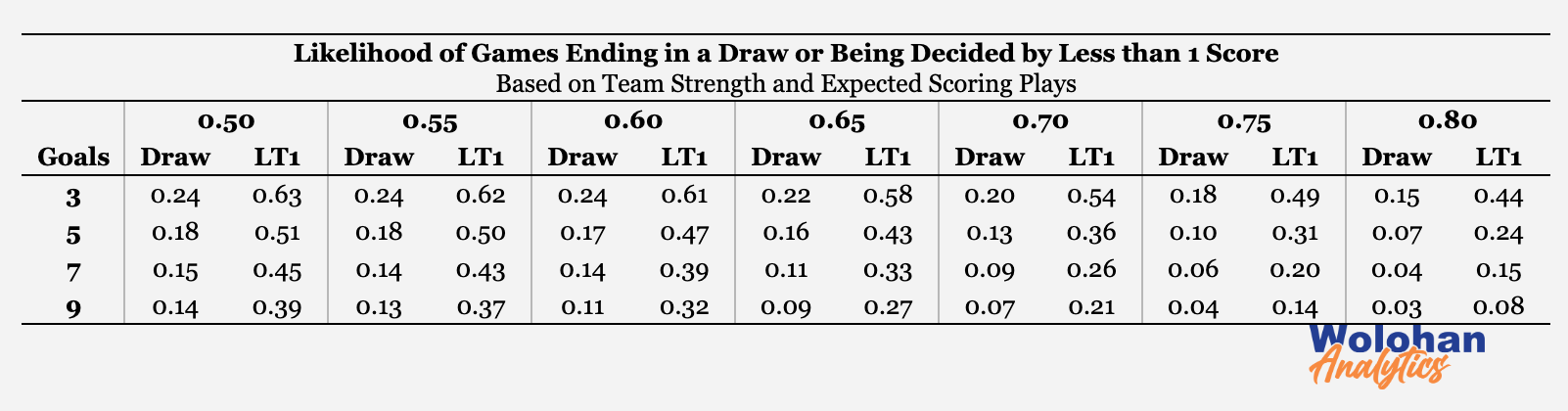
For two nearly matched teams (0.55) moving from 3 goals per game to 5 goals per game increases the likelihood of a definitive outcome – 2 goals or more separating the teams – by 12%. The likelihood of a draw in that same case decreases by 6%. Which is good – the two teams here are not evenly matched!
If we look at a more extreme case – 0.65, which approximately represents the strength of a strong NFL team versus a weak NFL team – we can see that at EPL levels of scoring (3 goals expected per match), we see draws 22% of the time and narrowly decided games 58% of the time. If we move to 5 goals, we get a 6 percentage point reduction in draws and a 15 percentage point reduction in narrow outcomes.
For wide differences in talent – the 0.80 level, which is what divides elite European soccer clubs from the bottom dwellers of European top leagues – moving from 3 goals to 5 reduces the likelihood of drawing or a narrow victory by nearly half. The result is a doubling of our measurement power!
Ultimately, soccer is under no obligation to change – and likely won’t make any tweaks to a system that works in the market. The sport has billions of fans, which in turn draws in lucrative sponsorship and broadcast deals. There is no real pressure on soccer to improve the sport.
But as it is now, the sport is broken. Because there is so little scoring, the chance of a poor team forcing a draw against a much more talented team is far too high. The actual game of soccer is nearly indecisive, and goals do not give us as much information as they should.
Soccer’s low scoring nature is a unique trait of the sport, that marks it as different than others. From the 8 to 10 or so scoring plays in an average baseball or football game, to the hundreds in a basketball game or tennis match – soccer is an outlier at the lower end of the scoring distribution.
And while it makes every goal matter to determine a game – it makes it also cheapens those same outcomes and makes the sports results mean less, not more.