


In a recent post, we noted that soccer is uniquely bad at measuring team strength: the low number of goals scored does not give soccer as much “power” to detect differences between teams as other sports.
Consider a recent tennis match between Novak Djokovic and Felix Auger-Aliassime. Djokovic won the 5 set match after 5 hours and 15 minutes of play, having scored 189 points. His opponent, Auger-Aliassime scored 185 points. Djokovic claimed the victory winning only 50.5% of the total points scored.
On the same day, Jannik Sinner beat Jan-Lennard Struff in straight sets, elapsing just 2 and a half hours. Sinner won 114 points (56%) to Struff’s 95 (44%).
There are two important things to note here.
First, tennis differentiates winners and losers with a finer tooth comb than soccer. Sinner has been in the running for top player in the world for the last few years and, apart from his rival Carlos Alcaraz, there has not meaningfully been a competitive third (though Sacha Zverev has an almost uncontested claim on that third spot.)
In a soccer context, we would expect Sinner and Alacraz to destroy their opponents. In the 2025-26 EPL season, Arsenal scored +70% of the goals in their matches. However, even in the most nominally lopsided game of Wimbledon – Sinner’s first round matchup against a player ranked 50th – Sinner won only 55% of the points.
Second, tennis is structured to end early if one player is better than the other, and only adds additional gameplay if it is needed to differentiate the two players. This is a massively unique set up, really only seen in reverse in youth sport with the “mercy rule” where the game automatically ends if a team falls too far behind.
It is obvious why sports are reluctant to do this. A fixed duration event is easier to profit off of and schedule around. When leagues get most of their revenue from television contracts, optimizing their sport around being a television product – as the NFL has – is an obvious way to increase league and franchise value, and commensurately, player salaries.
Both these points work together to emphasize a key reality about sports: they’re man-made systems, and their outcomes are down-stream from the structure of those systems.
Systems of Sport
From an analytics perspective, we are mostly concerned with the impact a sport’s design has on how well it lets us differentiate the good and the bad, or what components of a sport are implicated in being good or bad. Across sport, some sets of rules make this easier and some make this harder.
A simple example is indoor track and outdoor track. Indoor track and outdoor track are effectively the same sport, but outdoor track has added complication of temperature and wind. Over short distances – 100m to 400m – the aerobic system is not heavily taxed and so temperature is less of a factor; but times are fast and so even modest tail wind can increase times a meaningful amount. This is such an established factor that a significant wind invalidates times from world-record consideration. Over longer distances – 3,000m to 10,000m – heat does become a significant factor.
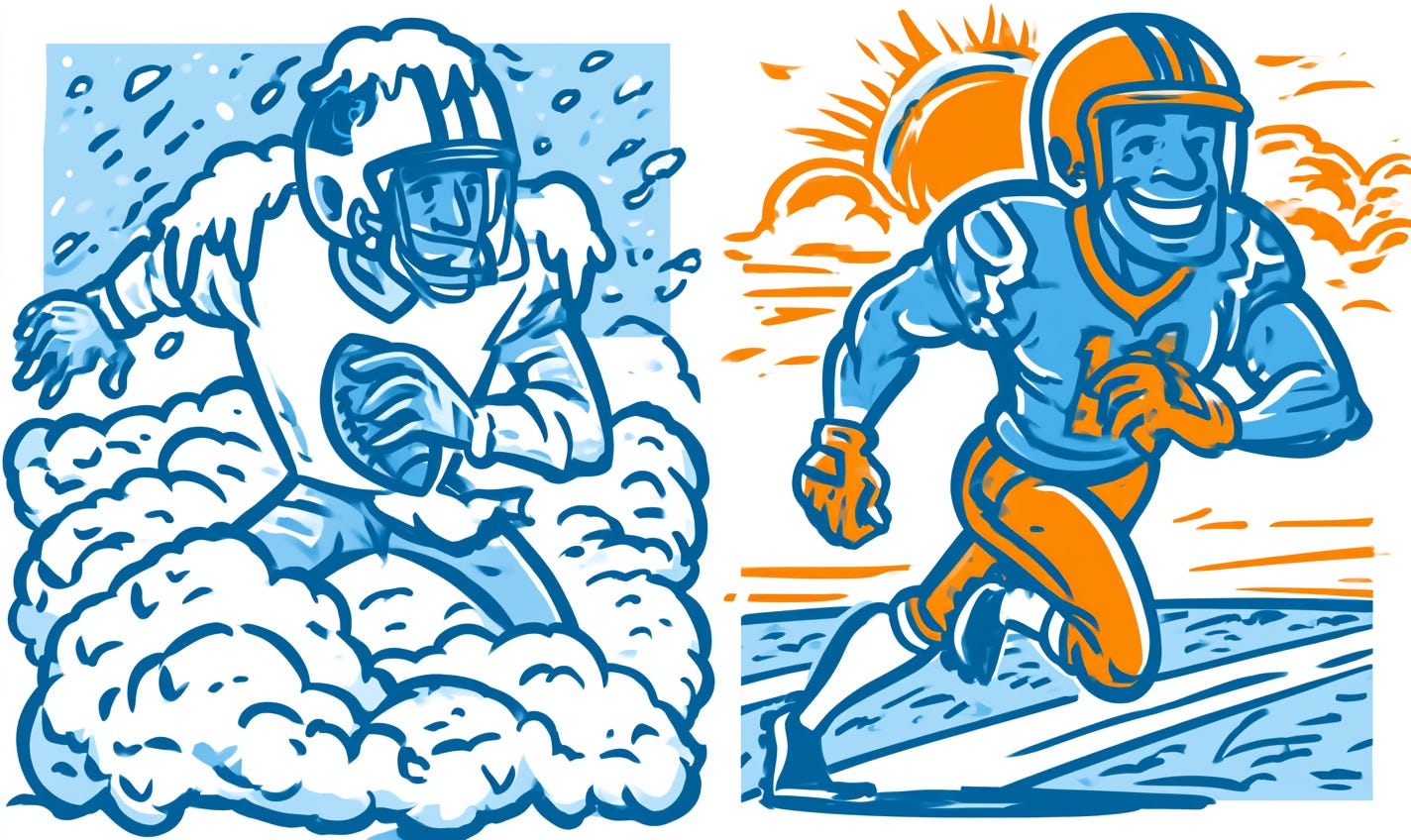
We can think about matters like this as issues of environmental randomness or a properties of athlete ruggedness. Like indoor and outdoor track, every sports differs in their rules as to how much they allow this to alter play. Football allows for a lot of this effect; soccer and baseball allow for some, but much less; basketball and hockey allow for almost none. This makes football less predictive than basketball because wind, snow, heat, and rain can – and often do – determine games.
Another thing we can think about is the complexity of a sport or the skill versus athleticism curve. Some sports are athleticism dominant, while others are skill dominant. And within a sport, some positions are more athleticism dominant and some are most skill dominant.
Defensive line, for instance, requires more athleticism than playing quarterback, which requires more skill. A defensive lineman who is massively heavy, brutishly strong, and blazingly fast will be good on the field of play. However, physical characteristics are rarely sufficient to make strong assertions about the quarterback’s potential.
Again, track is a good examples of an extreme. A track athlete must excel at an athletic trait, namely speed or endurance for runners.
Tennis is a good example of an extreme in which skill matters. Even though strength and biomechanics contribute to serve and rally shot speed, skill and ball placement, are the determinants of good performance.
The more skill is required, the older athletes can be and still remain competitive. Phil Mickelson, for example, won the PGA Championship at nearly 51 years old! Athletic qualities, especially explosiveness and ability to recover from intense efforts, begin to decline sharply towards the late 30s. The oldest ever NBA scoring champion, for instance, was Michael Jordan at age 35.
We can also think in terms of team dependency versus individual exceptionalism. Individual sports, obviously, rest entirely upon individual exceptionalism; but among team sports, some sports are more individual focused than others. Smaller team sports, like basketball, simply have less room to hide than large team sports, like football. And in a sport like baseball, the one-on-one nature of the duel between a pitcher and a batter isolates individuals. Despite the large team size, there is almost no teamwork or team tactics.
Then there is the structure of the contest itself. The most obvious sport for this is cricket, which has three international structures: Test Cricket, One Day Cricket, and Twenty20. In Test Cricket, matches are played over five consecutive 6-hour days; in One Day Cricket, up to 100 overs are bowled in a single day; and in Twenty20, each team gets one inning with a maximum of 20 overs.
Though each of these contests is similar, there is a difference in strategy in an alternating-play game that takes days, versus a much, much more concise version that concludes in 1/10th the time. There is also a difference in what we learn about the teams.
A team that is less talented can remain competitive for longer in 3 hours of play than they can in 30 hours of play.
We might also consider variations of basketball like NBA 5-on-5, FIBA 5-on-5, FIBA 3x3, and BIG3’s FIREBALL3:
FIBA 5-on-5 is a shorter game, with a closer three-point line, and rules that allow for tighter defensive play.
FIBA 3x3 is contested by 3 players per side, over up to 10m of play, in half court, and the first team to 21 wins.
BIG3’s FIREBALL3 is 3 players per side, first to 50, win by 2, halftime at 25.
These games are all basketball, but the 5-on-5 version of basketball emphasizes different qualities than the 3x3 version of basketball. The 3x3 version of basketball is even more individual performance dependent, and – with shorter play times – it is going to be easier for a hot streak to mask real talent discrepencies.
The list so far is certainly not exhaustive, and we would be remiss if we did not mention one more source of measurement (and fan) frustration: refereeing. The fickle, pernicious, corruptible, and ultimately human nature of refereeing is a massive source of error in sport. And how much or how little referees play into a game determines how precise the outcomes can be.
True to form, referees have almost no say in track and field contests. Apart from false start calls and disqualifications, the runner who crosses the line first wins.
In contrast, sports like soccer and basketball are defined by constant small violations of the rules of play – and the referee is tasked with the unenviable task of balancing calling fouls while also keeping the game moving in an entertaining fashion. In basketball, in particular, there is a saying “they can’t call them all”, referencing how a large volume of low-impact fouling can result in free advantages for the fouling team.
In a sport like professional football individual fouls and penalty calls can have a dramatic impact on play. Pass interference, most dramatically, is a spot foul, resulting in the ball being placed at the spot on the field where the pass may have been caught – had it not been for the foul.
The reliance on refereeing in this sense makes games harder to predict, as referee decisions – and the lack thereof – can and do alter the outcome of games.
Ultimately, the rules of a sport define how sensitive it is to discrepancy in capability. Some sports like track are very sensitive. Others, like soccer, are much less sensitive.
For professional sports, we want some amount of sensitivity. This helps us trust that the outcomes sport produces are meaningful. Sensitivity, however, is not all we want. We also want contests that can be concluded in a reasonable amount of time, and preserve some suspense.
It is the task of sports commissioners and their governing organizations to determine how these considerations are balanced.